Sunday, October 11, 2015

Media picks, September 17 - October 11

Health & Balance

1. A must read. All of it.

Relationships, Communications

2. Happy people vs. empathy:

…people who are generally cheerful are not so great at reading other
people's negative emotions, though what's especially interesting is
that they think they're very good at it.

3. 10 psychology studies every lover (or just human) should know. #6, 7, 8, and 10 are about healthy relationships in general.

Thursday, September 17, 2015

Media picks, Aug 23 - Sept 16

Health & Balance

1. According to the new research, sleep position might affect how efficiently the brain clears waste. The article includes an illustration of the recommended pose.

2. An alarming article on what insomnia might mean and what the lack of sleep can lead to. Bottomline: get enough sleep, no matter what — it will either save you from a neurodegenerative disorder or delay its onset.

3. Keeping a (kind of) one-sentence journal will make you happier.

Sunday, August 23, 2015

Blog news & media picks for Jul 19 - Aug 22

Hi there. Since the last post I've finished (!!!) 2 guides:

  1. How to use (free) Trello to speed up your personal projects and learning. A long one.
  2. Tiny tricks that do wonders. A relevantly short one.

But the biggest one is still coming. And growing unmanageably…

Media picks from the last ~30 days:

I. Health & Balance

3. What it’s like to have ADHD as a grown woman

Turns out, symptoms can be different for women.

II. Maker Skills, People Skills

4. A great health check for the quality of your learning & habit development: 

What have I changed about myself in the past 12 months?

(via)

5. Self-knowledge: an advanced version of MBTI test, with clear and well-structured explanations (Strengths & Weaknesses, Friendships, Career Paths)

Labeling can be limiting, tests can be unreliable, but while reading my profile I got reminded of some of the weaknesses and strengths I'd long lost awareness of, which has been helpful in my decision-making as of lately. Try it, that test isn't time-consuming. And is free.

6. Life of introverts, in graphs.

7. Science says that lonely people's brains work differently:

When people feel most alone, these results suggest their brains are not tuned in to smiles and laughter, they’re switched on to frowns and snarls — they’re vigilantly looking out for negativity without really knowing it.

III. Goodness

8. It's the end of summer already and the air is getting cold, so… this.


Sunday, July 19, 2015

Media picks, July 8-18

I. Health & Balance

1. Drop the "shoulds". A partial replacement for "have no expectations" guideline in Buddhism.

2. "for those high in neuroticism, higher frequency of fermented food consumption was associated with fewer symptoms of social anxiety" (via psychotherapy).

II. Writing Skills

3. The most freeing, encouraging writing guidelines I've seen: Neil Gaiman's 8 rules of writing. Go well with "Start telling the stories that only you can tell." I even set both links as a weekly calendar reminder.

III. Maker Skills, People Skills

4. A new classification of introverts. 4 types (can be mixed). Comes with a self-identification quiz. 

5. (pdf) A brief template for figuring out what job/project to choose.

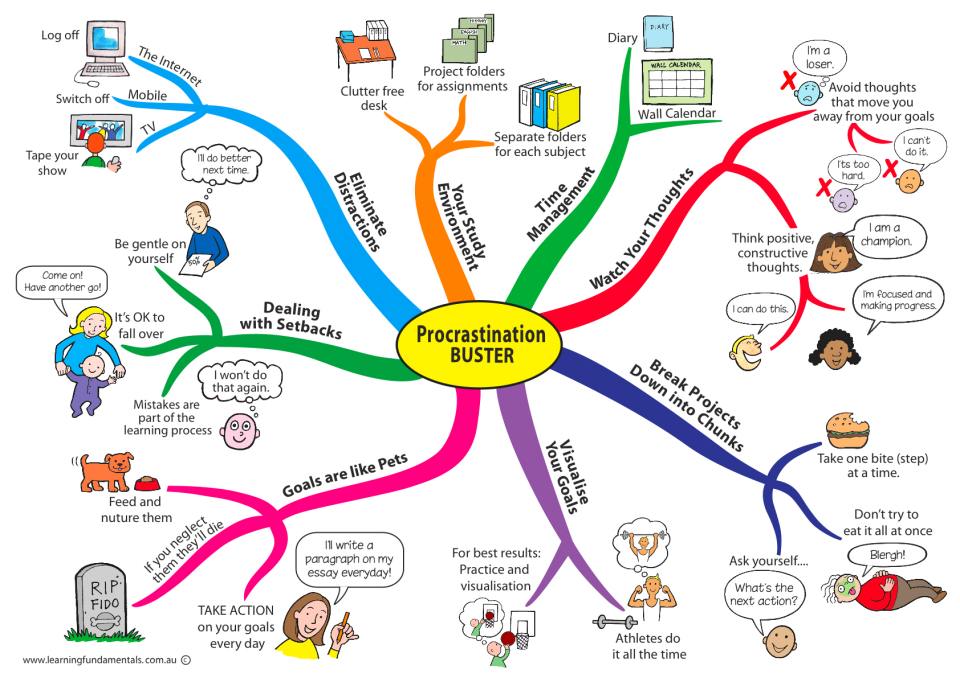
6. A mindmap for dealing with procrastination. “Goals are like pets… Feed and nurture them… Take action on your goals every day… If you neglect them they’ll die.”

IV. Goodness

7. What it’s like to be profoundly face-blind in NYMag's Science of Us column (via intotheprocess):
I'm always looking for visual hooks. My daughter has a particular thing she does with her mouth. If there’s several people who could be her, I look for the mouth thing. If she's nervous, or she's irritated, one side of her mouth goes up. She's done it since she was a baby. She doesn't like having her photograph taken, so when I look at a group photo, I look for the kid with the smirk and I know it’s my daughter.

…And some blog news: 
  • There is now email subscription available.
  • About page now has an email address listed.
  • And most importantly, I have 2 "real" posts drafted already (one of them is actually a how-to, so extensive that it has a table of contents!), they are coming soon.

Thursday, July 9, 2015

Media picks, May 19 - Jul 7

I. Health, Balance & Security

Science:

1. Surprising lists of what & how interferes with absorption of vitamin B1 (thiamine) and advice on how to decrease that effect.

2. A handy table of vitamin B12 absorption rates. Speaking of supplements that contain 1000%+ of recommended daily intake.

I have a great respect for vitamins B for the simple reason that I get 100% less neurotic when I get enough of them.

3. 5 tips for better posture (are under the image #2). And yes, "sitting for long periods can lead to the gluteal muscles atrophying" (includes an image of where they all are located).

Oh, and as for the tip #1, shoulder roll is demonstrated here (free registration is required). That thing just works — brings immediate relief to the shoulders and keeps them "open" for quite a while.

Warmth & speeding up:

2/3 of the money I made in June was mostly thanks to

4. The Heavy - What Makes A Good Man (Radio Edit)

on repeat, in the headphones or as an ambient noise (headphones lying nearby — works well in case of a particular level of exhaustion; is non-intrusive, but still has a speeding-up effect). Radio edit version has an immediate fast start, that’s why its "speeding up" effect is much stronger compared to the original.

…and the remaining 1/3 was facilitated by

5. Handel - Messiah (1959, Thomas Beecham) - CD3.

CD3 has a warming-up and hope-inducing effect, and #4 in it is also energizing. And I’m not into religion.

II. Maker Skills, People Skills

6. A small book called The Go-Giver. Is an addition to the list of great edu books.

I believe it was recommended by someone big & startup-related, but by now I can't track down where I saw it…

III. Writing Skills

7. Spring 2015' issue of The Paris Review: an interview with Lydia Davis.


Tuesday, May 19, 2015

Media picks, May 7-18

I. Health & Balance

1. Highly processed foods are among the most addictive.

2. Tony Robbins: The 3 Decisions That Will Change Your [Financial] Life (the text part, not the video).
  1. Carefully choose what to focus on ("Where focus goes, energy flows"). 
  2. Find an empowering meaning in any event. Epic failure -> epic learn (a fun example by Pitbull).
  3. What will you do? ("You can’t change your patterns if you’re not aware of them.")

II. Security

3. How to make it out of a free-falling elevator alive (video). Worth watching to the very end.

4. 11 common tech myths you should stop believing today. Stuff about batteries was enlightening. Also: you should shut down your computer every night if you want to increase its lifespan.

III. Maker Skills

5. Figure out what you are good at (and whether you should change your job/profession) in just 2 steps.

6. 3 reasons to never take another job (I like it for its #3). Scroll down to the actual 1-2-3 list — it is there, but almost in the very end. The pep talk under the list is also helpful.

7. Two powerful exercises from Tim Ferriss:
  1. A simple 3-step exercise to overcome fears. As a whole, it fits into "Prepare to be wrong" element of WRAP model of decision-making. Is also a partial how-to guide for Rainer Maria Rilke's "Anticipate change as though you had left it behind you" advice in Sonnets To Orpheus.
  2. A simple productivity hack for planning your day.

Thursday, May 7, 2015

Media picks, April 12 - May 6

I. Health & Balance

1. This is big: new research shows that saturated fat is bad for your cognitive skills & memory and monounsaturated fat is good. And, apparently, polyunsaturated fat has no effect whatsoever.

2. A TEDx talk (~19 min.) on self-compassion and, particularly, self-esteem vs. self-compassion (I posted its one-paragraph version on tumblr) by Kristin Neff (Ph.D.), who is an author of the pretty popular book I've seen great quotes from, Self-Compassion.

3. Beware social nostalgia. Get rid of your one-dimensional view of the past and you will be able to grow. "…memories, like witnesses, do not always tell the truth, the whole truth, and nothing but the truth."

II. People Skills & Maker Skills

4. You are an experience. Fits into "be the change you want to see in the world" concept.

5. Patti Smith: Advice to the young (6 min.).

6. Miranda July makes 2 great points about artists' relationships with fans. Plus some fun.

Monday, April 20, 2015

Media picks, March 14 - April 19

I. Health & Balance

1. According to the recent studies, people who frame events in their lives—even negative ones—in positive ways have better mental health. The article provides a description of 4 major themes you should pay attention to if you want to reframe your personal narrative into a healthier one.

2. Brene Brown's another way. I recently got really excited about her book.

3. One more benefit of eating broccoli: "sulforaphane slows down the destruction of cartilage in joints associated with …osteoarthritis. …Sulforaphane is released when eating cruciferous vegetables such as Brussels sprouts and cabbage, but particularly broccoli".

II. Maker skills

4. A clear explanation of the WRAP model for decision-making.

III. Warmth

5. "I Followed My Stolen iPhone Across The World, Became A Celebrity In China, And Found A Friend For Life" travelogue by a BuzzFeed writer.


Saturday, March 14, 2015

Media picks, March 2-13

I. Writing skills

1. Checklist: Is this content valuable?

2. Sales writing: You don't really know your customers, unless… you can finish their sentences (e.g., "Submit" to be replaced with "Start my trial").

II. Maker skills

3. BigThink video (2:39 min): Neil deGrasse Tyson' advice.

4. BigThink video (2:34 min): The Common Character Trait of Geniuses (answer: deep focus).

5. Video (2 min): Richard Branson's top 5 tips for becoming an entrepreneur (2012).

III. Voice

6. Pauses & voice modulations in this video (3:56 min). Would love some of the pauses to be longer though.

IV. People skills

7. The practice: Bless.
Blessing does not mean approving; you can wish people well while also disengaging from them.

Fundamentally, blessing means treating another person as a “thou” not an “it,” not a means to your ends. Think of “thou” as a verb. To bless people is to thou them.
8. Video, first 44 seconds: Richard Branson' advice.

9. Quiz: Feeling cared about (pdf). One of the statements to be rated:
I’ve reflected a lot on my childhood, and I have an accurate, well-rounded understanding of the ways that my parents and other key caregivers related to me – especially as a young child – and how this affected me while growing up.

Monday, March 2, 2015

Media picks, February 23 - March 1


1. Smiling changes your brain.

2. Two Easy Ways to Feel Like You Have More Time. A set of 10+ deep breaths is one of them.

3. Classifications of satire: Horatian vs. Juvenalian vs. Menippean.

4. See deep wants.
When you recognize the deeper wants of others, they feel seen and are less likely to be reactive.
5. "The price of admission" in long-term relationships.

6. Marion Cotillard's Screen Test with Lynn Hirschberg, 2015.

Sunday, February 22, 2015

Media picks, February 16-22


1. Entrepreneurial Shame... I'm doing well but haven't really worked for years.

An enlightening read, including the top comments.

The day is the only unit of time that I can really get my head around. Seasons change, weeks are completely human-made, but the day has a rhythm. The sun goes up; the sun goes down. I can handle that.

…We’re all busy, but we all get 24 hours a day. People often ask me, “How do you find the time for the work?” And I answer, “I look for it.” …You find it in the cracks between the big stuff—your commute, your lunch break, the few hours after your kids go to bed. You might have to miss an episode of your favorite TV show, you might have to miss an hour of sleep, but you can find the time to work if you look for it.
3. What pushes scientists to lie? in The Guardian
…Not only are most experiments not reproduced, most are probably not reproducible. This statement will shock only those who have never worked in a wet lab. Those who have will already suspect as much.

…In anonymous surveys, almost 2% of scientists actually admitted to falsifying data at least once in their careers, and about 14% had witnessed others doing so.
A reminder to be sceptical if there is only one study that supports an interesting finding.

4. Thomas Newman — Whisper of a Thrill

Rediscovered the movie yesterday.

Monday, February 16, 2015

Media picks, February 9-15


1. An hour-long interview with Lena Dunham, by a good interviewer (Jan 14, 2015)

One of those videos that make you very aware of the cultural level of your current social environment and the quality of your life.

I liked the 1st season of Girls, then lost interest somewhere between the first episodes of season 2 (or 3?), but this interview was interesting, enjoyable anyway — she is very well-spoken and level-headed here, plus some useful stuff is being discussed, plus she is friendly with the interviewer, so there is a relaxed and trustful atmosphere.

But the disappointing thing about more or less in-depth interviews with artists is that you inevitably find out that there were just particular events and experiences that gave those people the unique sensibilities/obsessions/level of confidence they are praised for now (e.g., a theatre camp as a small kid? with Meryl Streep' daughters?). I.e. the whole magic gets dispelled: you are reminded that those artists weren't born jewels — their upbringing, social environment had a lot to do with the outcome (+ work, but that's just about learning to channel oneself out in a packaged way, so…).

Not sure why it is disappointing… Because magic is fun? Because I start feeling more responsible for finding use to my own "jewel" stuff?

2. A 25-min long interview with Miranda July, by an inexperienced interviewer (Feb 4, 2015)

The interviewer' behavior is occasionally cringe-inducing (but of course he will get better with experience), so I watched this video with skipping.

Top 3 things:
  • master/servant modes (was a timely reminder);
  • curiosity: artificially increasing stakes, to motivate oneself;
  • curiosity: "somebody is watching, you have to do a good job, be a good person" frame of mind
And that she stayed visually unperturbed throughout it, despite the interviewer' mistakes. 

3. The Cruelty Crisis: Bullying Isn't a School Problem, It's a National Pastime by Brené Brown, 2010

I saw her TED talk about vulnerability years ago, liked the way it was done, enjoyed/related to the comedic moments, but wasn't able to receive the "message" — it was unclear how to apply what she talks about to my life.

But this article gives clear answers.

4. [ a photo I'm not going to share here ]

Made me realize that within 1 to 12 months the region I live in might become a place to move away from, if I'm interested in staying alive and functional. 

It all can turn into a "joke", or not. Nobody can predict anything. "Defensive pessimism" is a right thing to focus on, that's for sure. 

And my subconscious keeps forcing me to finally read The Diary of Anne Frank.

5. Maria Callas - One Fine Day (Madame Butterfly)

It just happened. I came across The Guardian's Q&A pieces with artists (e.g., Bjork, Miranda Hart), and they have there a question about a song, and from the ones I checked out One Fine Day is the only one I wanted to listen to again, and then again, and again.

Oh, and the most frequent answer about the key life lesson in the Q&As I've read is… humility.

And invisibility as a superpower, which was comforting to me, but surprising.

Sunday, February 8, 2015

Media picks, February 2-8

1. Seven Cardinal Rules For Life


4 of them were extremely timely…

Discovered via Tumblr. The most viral content item I've seen so far (897,209 notes as of now).

In some old blog posts these rules are attributed to Stephen Covey (of The 7 Habits of Highly Effective People), but without references to any specific source (book, interview, speech). Additional googling didn't clarify the situation.

The photo above is actually of the poster available on Zazzle.

2. Colm Tóibín's recap of a book about Thomas Mann' children

A mix of dirty laundry and a cautionary tale.

Provides a whole bunch of possible plots for a novel, if you are looking for one.

Made me want to read some novel about a big family and multiple generations. And to stay away from biographies.

3. Brain + complex environments = evolution

A short must-read for every human.

4. "A simple intervention can make your brain more receptive to health advice"

One more argument for the usefulness of affirmations.

5. The Guardian's 1000 novels everyone must read

I remember seeing this list in sections (by genre, with short reviews for each book), but somehow have never come across this handy one-page version (hello, Ctrl+F).

Sunday, February 1, 2015

Media picks, Jan 26-Feb 1

(imagine here an eye-pleasing image that caughts your attention and eventually makes you read this whole post)


Fun

1. Bruiser (TV Show) - Nurse (it's an excerpt — a short Youtube video)

Olivia Colman in the sketch #2. Every choice she makes is pitch-perfect.

2. Olivia Colman's both Bafta 2013 speeches.

Is now on my list of best award speeches ever.

3. This and this bit from Rachel Maddow' appearance on Dave Letterman Show, January 28

I don't watch her show (have no interest in American politics), but there are moments of pure joy in each her appearance on Letterman.

She is bright, she is really good with words & intonations, and it's a pleasure. And this time she and Dave Letterman play great together.

Serious Stuff

4. Bits from Claire Dorotik-Nana's January articles on PsychCentral 

(Discovered via psychotherapy tumblr, have some quotes on my tumblr.)

She talks about what's not right and for each issue offers "fixes" — several questions to ask oneself.
But those 3 articles will take more than a day to process. I'm still in the process, actually.

5. The original and the follow-up NYTimes' articles on the topic of "The 36 Questions That Lead to Love"

The experiment was based on the study by the psychologist Arthur Aron, and the second article actually provides the list of questions.

It's all pretty convincing, especially the thing about a lengthy eye contact.

For example, I was sent to a training in public speaking skills years ago, with my colleague. And one of the exercises was in pairs: you had to stand in front of the other person for several minutes and stare them in the eyes (to train oneself to maintain a strong eye contact with the listener(s)). I would say my experience matches the “Two minutes is just enough to be terrified …Four really goes somewhere” comment in the NYTimes article.

Sunday, January 25, 2015

Media picks, January 19-25

1. Masters of Love, The Atlantic

Some science-proved advice on healthy long-term relationships (marital, but the advice seems totally applicable to any long-term relationships with humans). 3 most useful things from there:
  • A clear definition of what healthy kindness is ("Kindness doesn’t mean that we don’t express our anger… but the kindness informs how we choose to express the anger. You can throw spears at your partner. Or you can explain why you’re hurt and angry, and that’s the kinder path."). 
  • A surprising fact: the research shows that, for relationship quality, it's more important to support person when they get good news than when the things get rough.
  • The classification of (1) passive destructive, (2) active destructive, (3) passive constructive, and (4) active constructive ways of responding to each other’s good news, with examples (one should aim for an active constructive way, “That’s great! Congratulations! When did you find out? Did they call you? What classes will you take first semester?”).

2. Hit the Reset Button in Your Brain, The New York Times

Finally, a clear explanation of why it's important to do similar things in batches, apart from the benefit of saving time.
My collaborator Vinod Menon, a professor of neuroscience at Stanford, and I showed that the switch between daydreaming and attention is controlled in a part of the brain called the insula, an important structure about an inch or so beneath the surface of the top of your skull. …If the relationship between the central executive system and the mind-wandering system is like a seesaw, then the insula — the attentional switch — is like an adult holding one side down so that the other stays up in the air. The efficacy of this switch varies from person to person, in some functioning smoothly, in others rather rusty. But switch it does, and if it is called upon to switch too often, we feel tired and a bit dizzy, as though we were seesawing too rapidly.
…If you want to be more productive and creative, and to have more energy, the science dictates that you should partition your day into project periods. Your social networking should be done during a designated time, not as constant interruptions to your day.
Email, too, should be done at designated times. 

3. Pitchfork's interview with Bjork (The Invisible Woman: A Conversation With Björk)

It turned out to be a perfect preparation for listening to her new album (I actually learned about its existence thanks to that text), and some songs from the album immediately (!) brought me back to my core. I didn't even realize that I had been lost.

4. This Old Man, The New Yorker

What it's like to be 93 in a first world country (because, based on what this man tells about his heart condition, if he had lived in my town or other part of the country even, he'd already be dead; and there would be no dating-sites visits). The surprising things are the "unceasing need for deep attachment and intimate love" that old people apparently have, and the author and his wife' confidence in how important it is for the surviving partner to remarry.